

Mike Judas
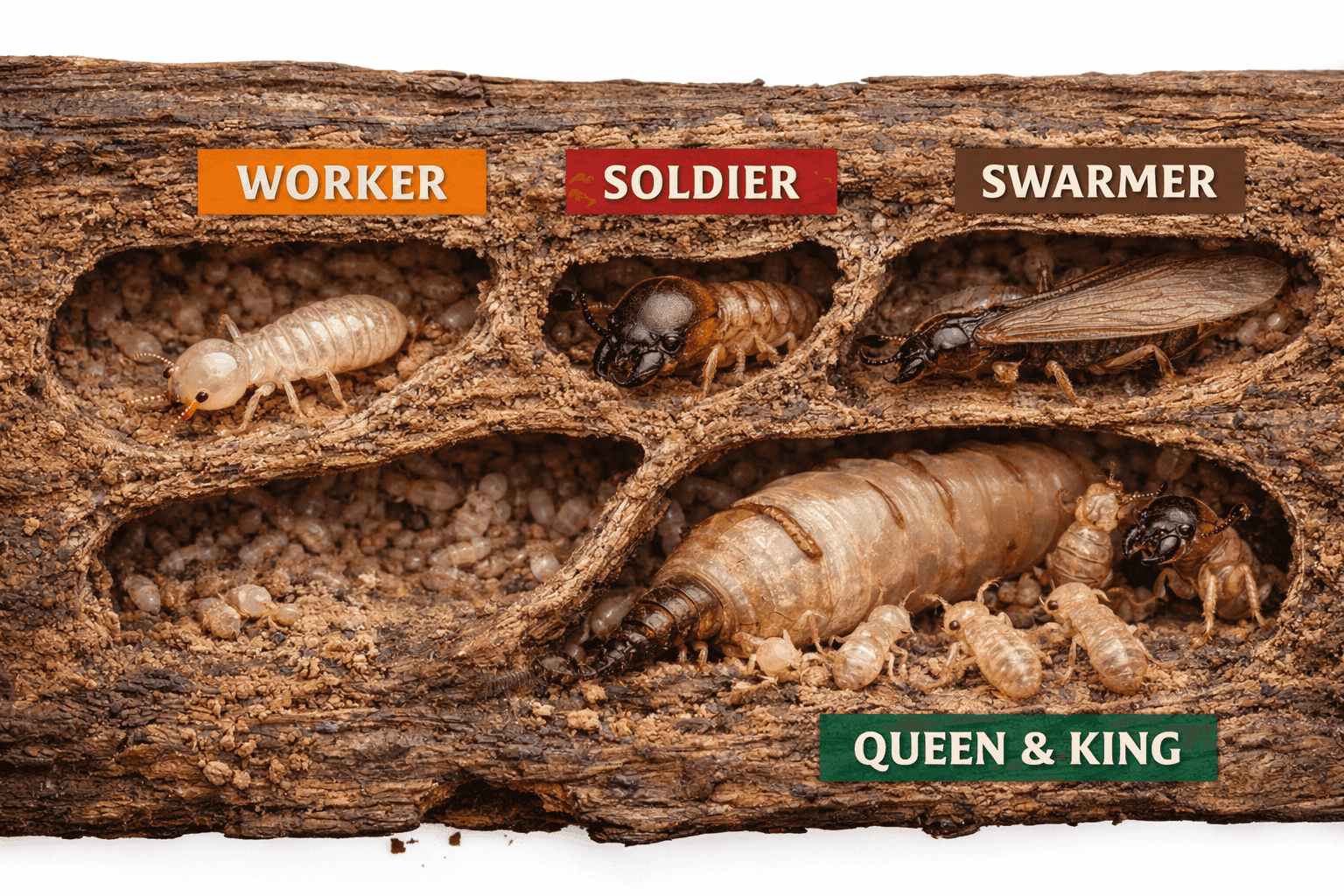
Termite Castes Explained
Workers, soldiers, swarmers, and the queen – the castes of the termite colony.
Colonies operate with a level of structure and coordination that often goes unnoticed until signs of damage appear. Understanding how each caste contributes to the colony’s survival helps homeowners spot problems early and choose the right treatment before destruction spreads.
In the United States alone, termites cause over $5 billion in damage every year.
Suspect you have termites in the Bay Area? Contact us for an inspection and consultation.
When you hear the word “termites,” you might picture a swarm of tiny bugs munching away at your home’s foundation. It creates a fearful vision in your head. And you’d be right.
Termites aren’t just random insects. They’re like a well-oiled machine, operating in highly organized colonies with a strict social hierarchy. This is called the termite caste system, where each group has a specific role, much like workers, soldiers, and royalty in a medieval kingdom.
Understanding this system is fascinating, but it also explains why termite infestations are so sneaky, hard to spot early, and even harder to get rid of on your own.
Termite Colonies: A Structured Society
Termites have been around for millions of years, evolving into efficient destroyers of wood. In the U.S. alone, they cause billions of dollars in damage annually. But here’s the key: not all termites are the same. Their colonies are divided into castes, each with unique jobs that keep the group thriving. This division of labor makes them resilient and dangerous. Let’s break it down step by step, starting with an overview of the caste system.
At their core, termite colonies are organized around three primary roles. Winged reproductive termites, often called swarmers or alates, are responsible for starting new colonies. Soldiers focus on defense, protecting the colony and its tunnel systems from threats. Workers handle nearly all of the activity that keeps the colony alive. This includes caring for eggs and young, gathering food, and building and maintaining the hidden tunnels that allow damage to spread unnoticed.
To understand how the caste system works, it helps to imagine a termite colony as a bustling underground city (or inside your walls, in the case of drywood termites). At the heart of it all is this system of specialized roles. While the exact setup can vary slightly depending on the termite species (subterranean, drywood, or dampwood), the core castes remain the same: workers, soldiers, and reproductives which include the queen and king.
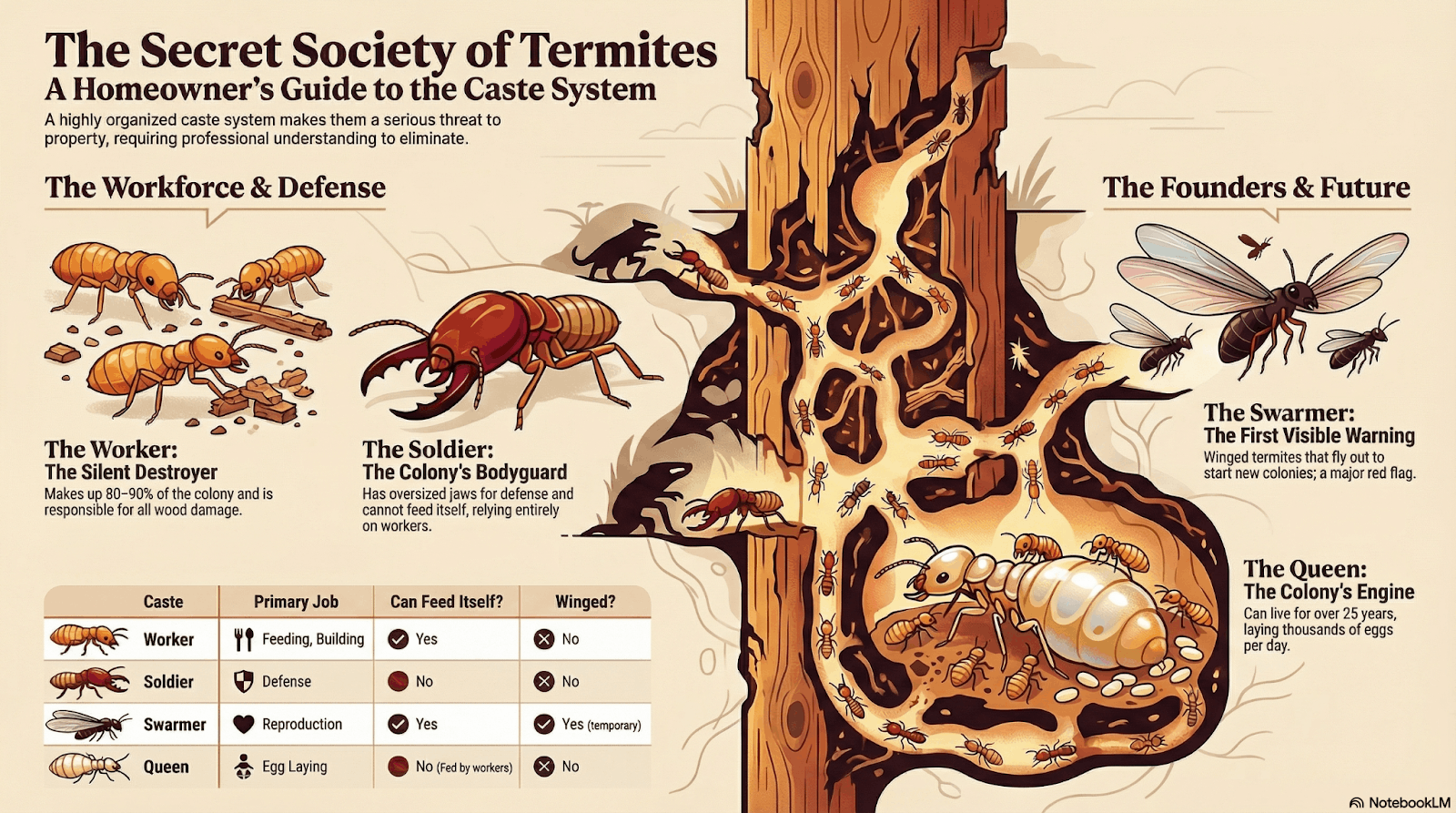
These roles aren’t random; they’re interdependent. Workers feed everyone, soldiers protect, swarmers spread the colony, and the royals ensure future generations. Without one caste, the whole colony could collapse. But in your home, that means a small sighting could point to a massive hidden problem.
Worker Termites: The Silent Destroyers
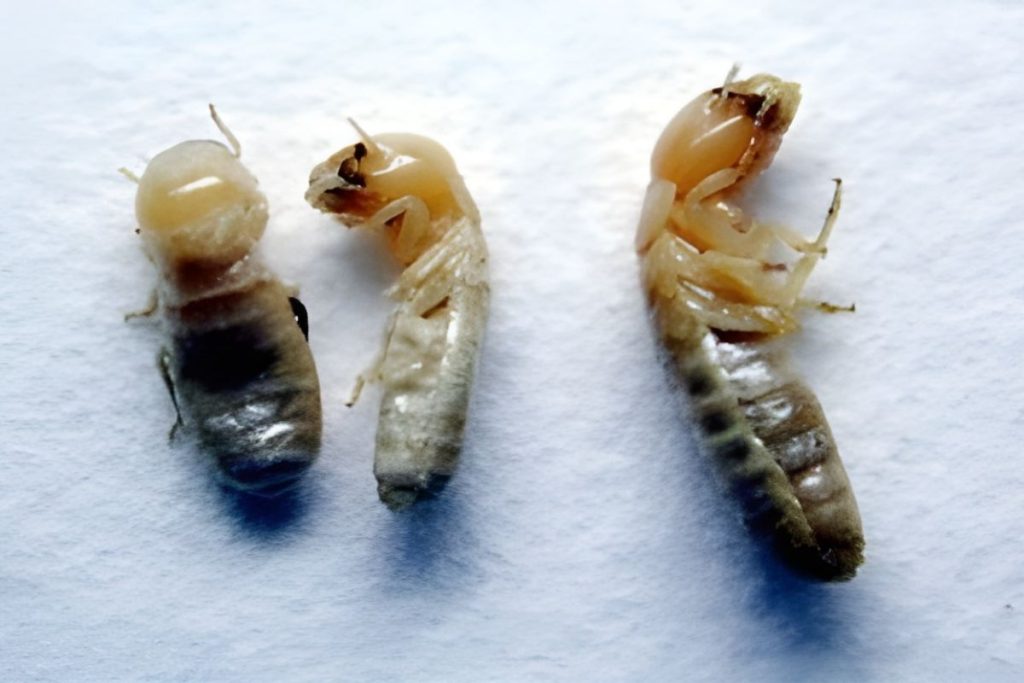
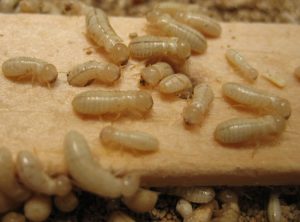
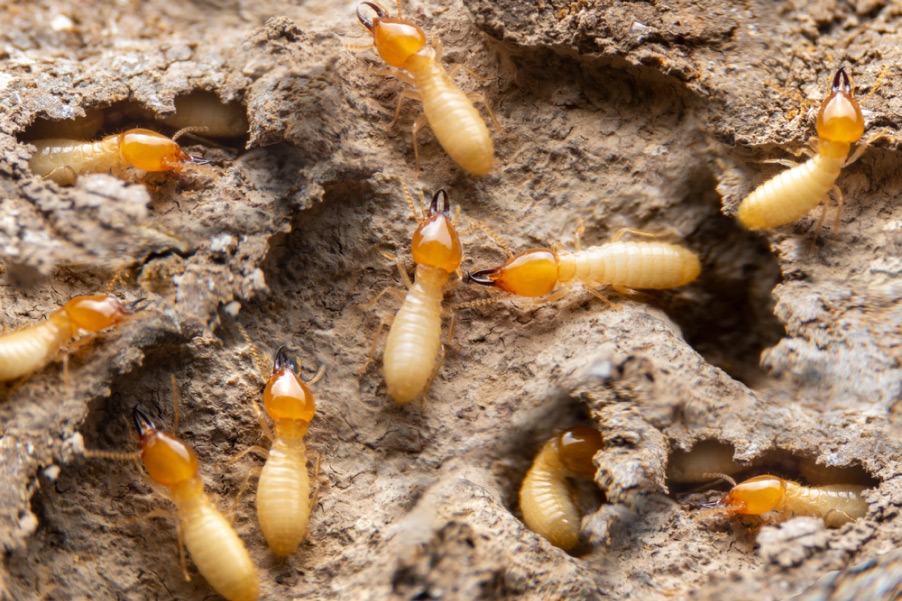
Drywood Termite Workers & Immatures (Image: University of Arizona – Entomology)
The workers do the damage. Worker termites make up the majority of the colony (often 80-90 percent) and they’re constantly munching on wood around the clock.
Termites have special microbes in their guts that help them digest cellulose, the tough stuff in wood that most insects can’t break down. As they munch, they create tunnels and galleries inside beams, floors, and walls. They don’t just eat. They build and maintain the colony’s home, keeping humidity levels just right to prevent drying out. Workers also care for the young, feeding them regurgitated food and tending to eggs.
Why are they so dangerous? Well, by the time you notice sagging floors or crumbling drywall, the damage could be extensive and costly. Subterranean termite workers build mud tubes to travel from soil to your home, shielding themselves from light and air.
Understanding termite worker behavior is key because they are responsible for nearly all structural damage.
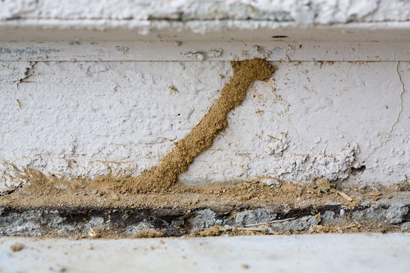
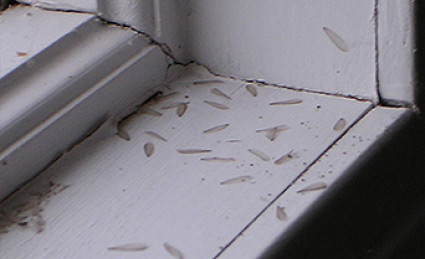
Subterranean Termite Mud Tubes & Wings on a Windowsill (Image: NC State – Entomology Dept)
In drywood termites, there aren’t “true” workers. Instead, young termites called immatures or pseudergates handle the labor. These versatile youngsters can later morph into soldiers or swarmers if needed, making drywood colonies especially adaptable. If you’re facing an infestation, spotting worker activity like frass (termite droppings that look like sawdust) is a red flag that the colony is active and growing.
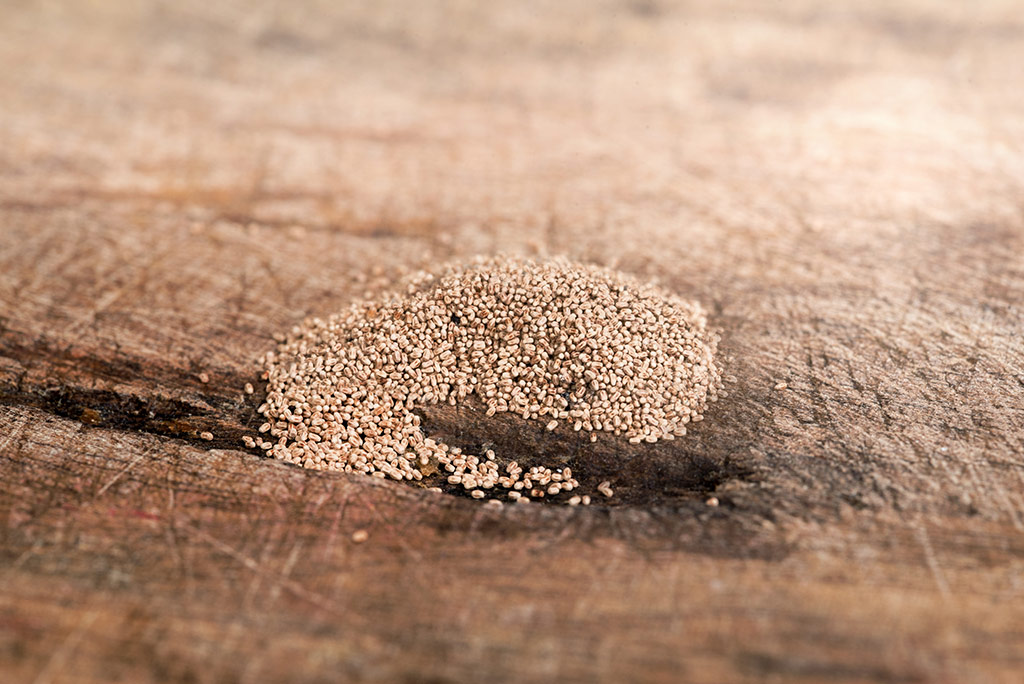
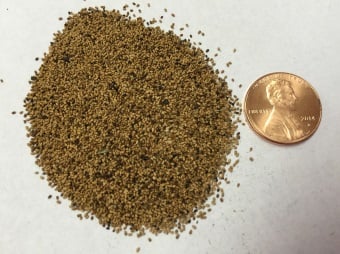
Drywood termite frass, indicating an active infestation
Soldier Termites: The Colony’s Bodyguards
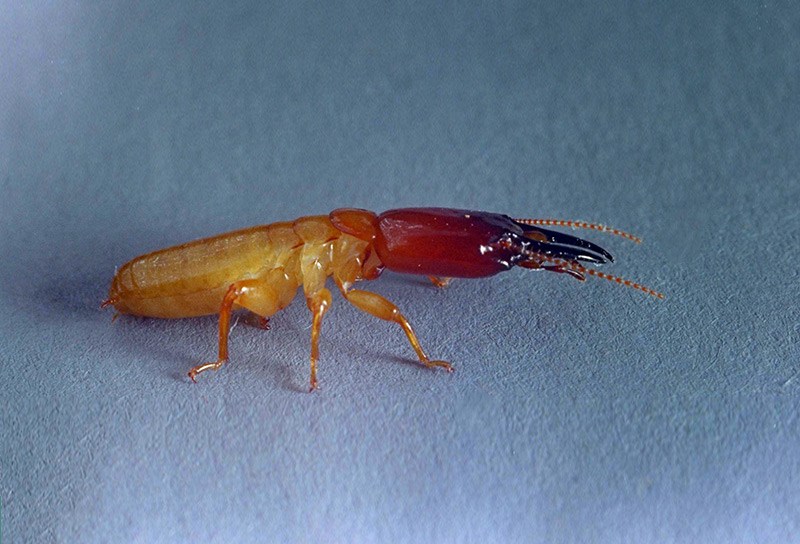
Subterranean & Dampwood Termite Soldiers (Image: Oregon Digital, licensed under CC 4.0 International)
Soldiers are the tough guys of the termite world. They don’t eat wood or build anything; their only job is defense. Making up about 5-10 percent of the colony, soldiers are equipped with oversized heads and powerful jaws called mandibles. Some species, like subterranean termites, have soldiers with snouts that spray sticky chemicals at intruders.
How do you spot them? Soldiers are a bit larger than workers, with darker, hardened heads that look armored. They’re blind, like most termites, but they sense vibrations and chemicals to detect threats.
In action, soldiers plug up breaches in tunnels if ants or other predators attack. They’ll even sacrifice themselves by blocking entrances with their bodies. But here’s a crucial point: Soldiers can’t feed themselves. Their massive jaws make it impossible to chew wood, so they rely on workers to regurgitate food for them. If you see soldiers during an inspection, it means there’s a full colony nearby, with workers sustaining them.
Soldiers highlight how interconnected the castes are. Without them, the colony would be vulnerable, but with them, it’s a fortified fortress. For homeowners, this means DIY treatments that only kill visible soldiers won’t touch the workers or queen, allowing the infestation to rebound.
Swarmer Termites: The Harbingers of Trouble
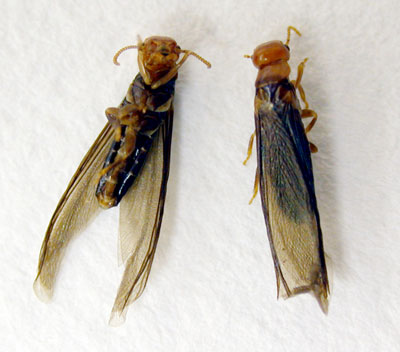
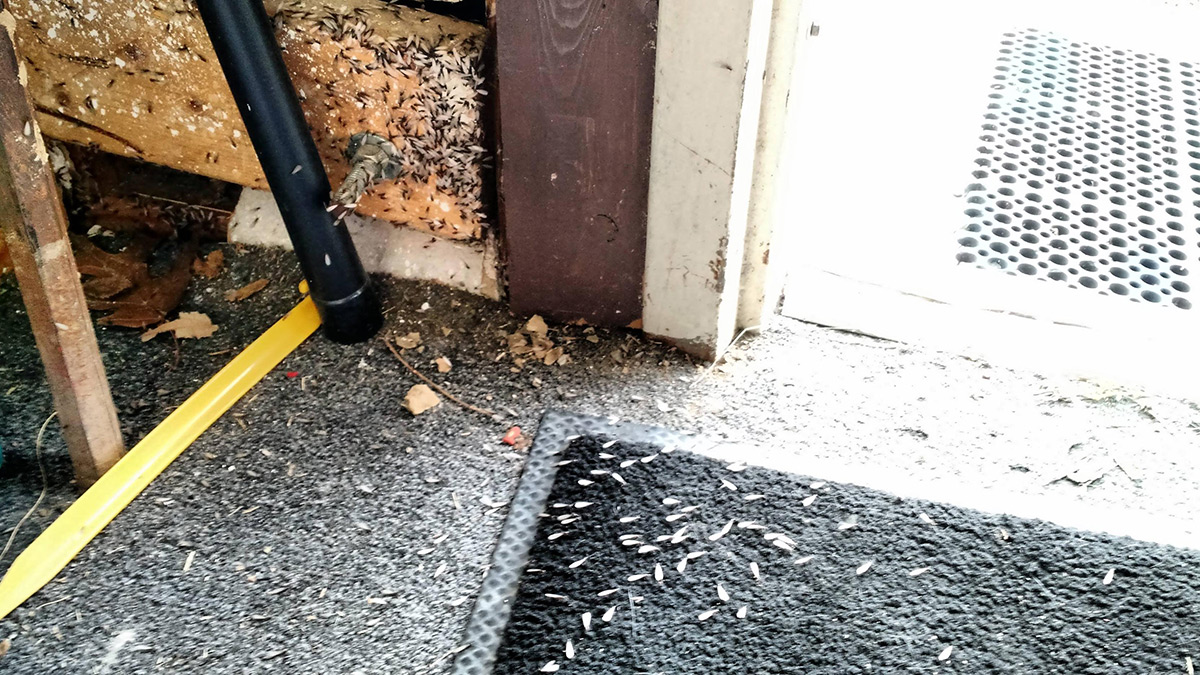
Drywood Termite Swarmers (Image: University of Arizona – Entomology)
Swarmers, also known as alates or reproductives, are the termites you’re most likely to see. They’re the winged ones that emerge in large groups, often mistaken for flying ants. But don’t be fooled. Swarmers have straight antennae and four equal-length wings, unlike ants with bent antennae and uneven wings.
Their role is simple. Reproduction and expansion. When a colony matures (usually after 3-5 years), swarmers fly out during warm, humid weather, usually in late summer for drywood termites or spring for subterraneans. They pair up, shed their wings, and start new colonies. A single swarmer doesn’t cause damage, but seeing them indoors is a huge red flag. It means an established colony is already in your structure, pumping out more termites.
The Importance of Swarmer Termite Identification & Early Warning Signs
Why do they matter so much? It’s important to know how to identify swarmers because they’re often the first termite infestation sign you’ll see. If you find discarded wings on windowsills or floors, it’s time to call a pro. Ignoring them could lead to multiple colonies in one home, especially with drywood termites that don’t need soil contact.
The Queen and King: The Royal Power Couple
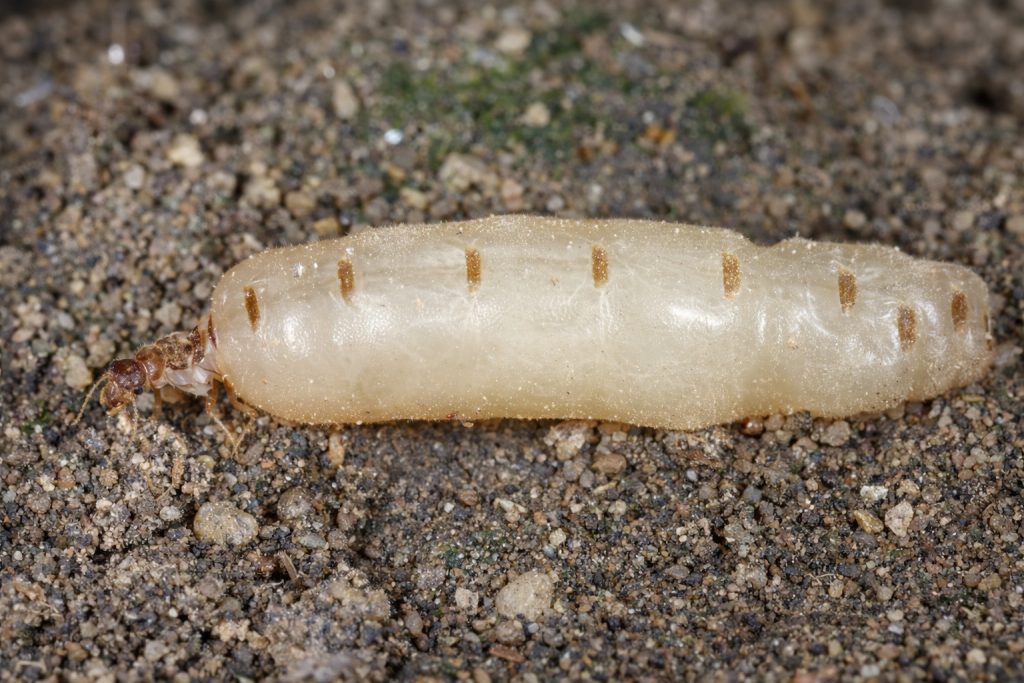
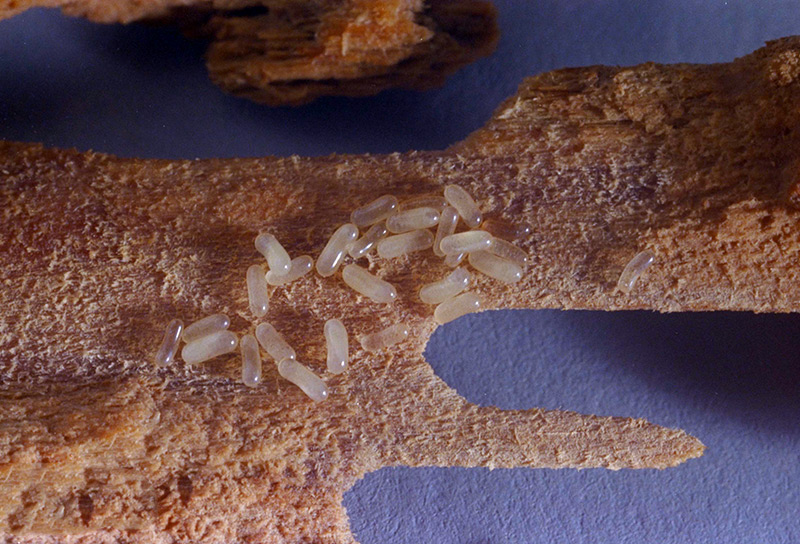
Termite Queen & Egg Mass (Image: Oregon Digital, licensed under CC 4.0 International)
The queen and king are the colony’s engine. The queen starts as a swarmer but grows massively, sometimes up to several inches long, with a bloated abdomen full of eggs. She can live 10-25 years or more, laying thousands of eggs daily. In massive subterranean colonies, a queen might produce millions over her lifetime.
The king stays by her side, smaller but essential for mating and colony regulation. Both are fed by workers, as they’re too large to forage. This royal pair ensures the colony’s growth, turning a few termites into hundreds of thousands.
Without the queen, reproduction halts, but she’s well-protected deep in the nest. That’s why spot treatments and orange oil treatments don’t work for larger infestations. They don’t reach her.
Do All Termites Have the Same Castes? Species Differences
Not all termites are identical. Although there are similarities, termite species differences in the caste system affect how they infest homes.
- Drywood termites: No dedicated worker caste; immatures do the work. Colonies are smaller (thousands, not millions) and live entirely in wood, no soil needed. This allows multiple colonies in one structure, like in attics or furniture. They’re common in warmer climates and harder to detect early.
- Subterranean termites: Have true workers and soldiers. Colonies can reach over a million, needing moist soil for survival. They build extensive tunnels, spreading damage quickly through foundations. These are the most destructive in the U.S.
- Dampwood termites: Similar castes but prefer wet, rotting wood. They’re less common in dry, maintained homes but can thrive in leaky areas.
For additional reading, visit our Termite FAQ.
How Franz Termite Control Treats Termite Colonies Effectively
 Everything is connected: Workers fuel the colony, soldiers guard it, swarmers expand it, and royals sustain it. Even if you kill a few visible ones, the rest adapt and recover. For homeowners, realtors, and managers, early detection is key. Signs like mud tubes, frass, or swarmers indicate active castes. Delaying action damages the compound, potentially costing thousands in repairs.
That’s where professionals like Franz Termite Control come in.
We don’t just treat symptoms; we target the entire colony. Our process starts with a termite inspection to identify the species, active castes, and infestation extent. Whether it’s workers tunneling through beams or swarmers signaling maturity, we assess it all.
Based on findings, we recommend the best approach: full fumigation for widespread drywood infestations or soil injection treatments for subterranean termites. Our goal? Complete eradication, whatever it takes, while considering your home and preferences.
Request an Estimate, Inspection, or Just ask a Question
Don’t delay! Get in touch with us today.
If your home hasn’t been inspected in a couple years or you suspect you have termites, contact us for a consultation and inspection.
Have rot damage or a new construction project? Get in touch with our consultants to learn more about our process and options.
- (650) 493-0445
- info@franztermite.com
- 4041 Transport St. Palo Alto, CA 94303
Share this post
Mike Judas
Michael Judas is the second-generation owner of Franz Termite Control, proudly continuing the family legacy started by his father, Franz Judas. Growing up in the business, Michael learned early on the value of hard work, integrity, and treating every customer’s home as if it were his own.
Under Michael’s leadership, Franz Termite Control has remained a trusted name in termite protection and damage repair across San Mateo and Santa Clara Counties.
More Blog Posts
Termite Prevention Tips
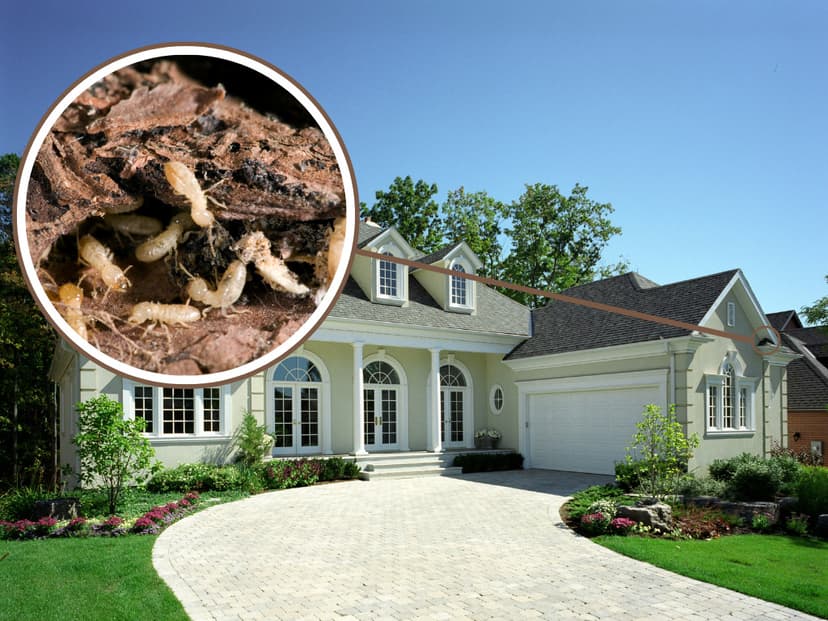
Your home is your fortress, and in the Bay Area, it’s under siege. Termites – silent saboteurs – tunnel through wood and soil, targeting Palo Alto, San Jose, San Mateo, Campbell, Mountain View, Milpitas, Redwood City, Los Gatos, and beyond.

Heat Treatment for Termites
As you would expect, we get lots of questions from concerned homeowners when they discover their home has a termite infestation.
Termite Fumigation: How to Prepare for Termite Tenting
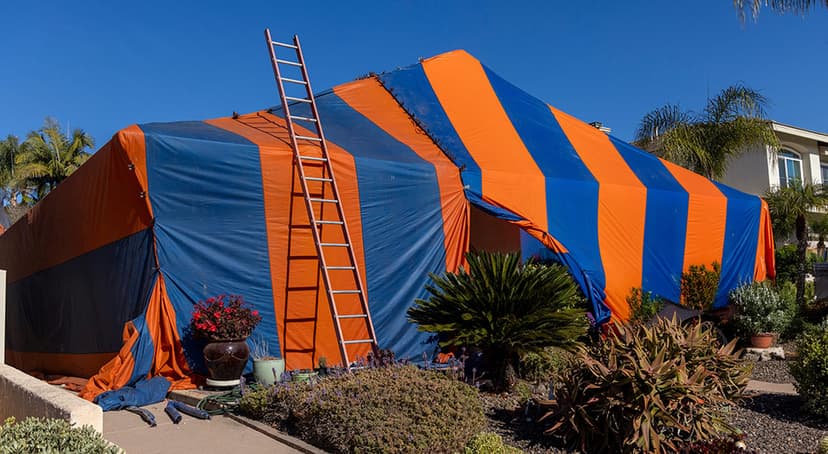
Franz Termite presents this stress-free fumigation & termite tenting prep guide & checklist for Bay Area homeowners. Learn how to prepare today.